
{主关键词}
杀马特
China-ASEAN Education Week 2026 wraps up in Guiyang, launches AI platform for traditional medicine_我的网站

一 |
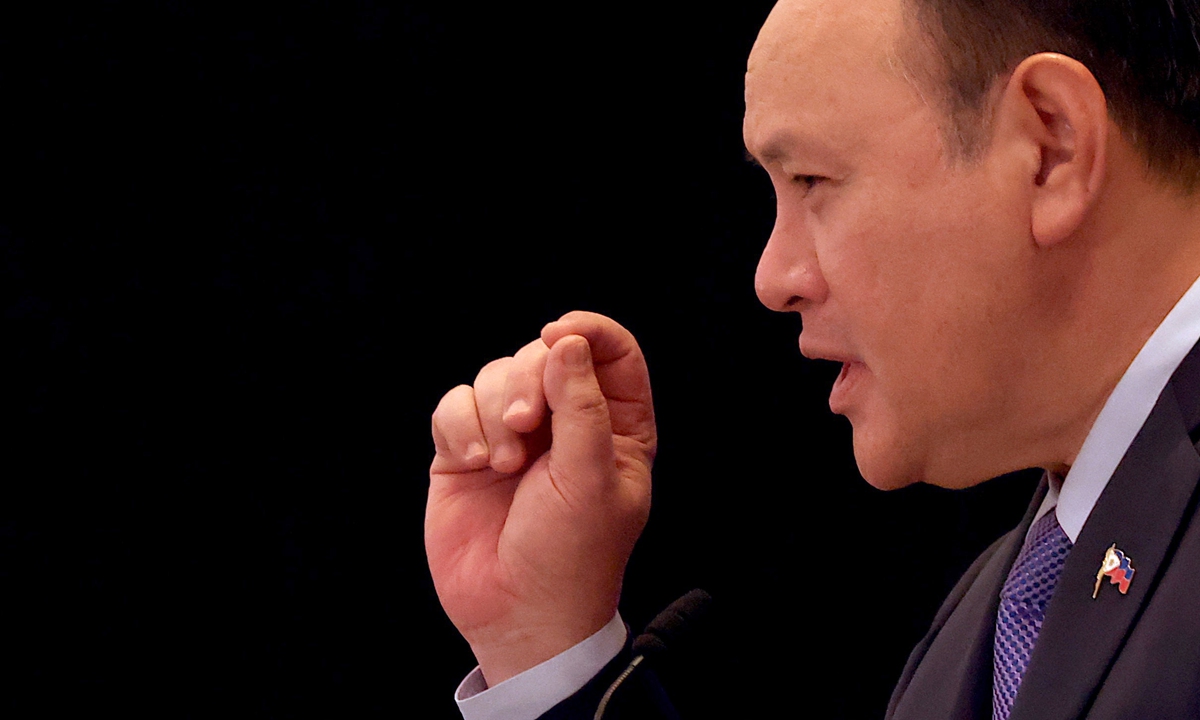
The statement came after Teodoro, who was sanctioned by China in June, accused the Chinese Foreign Ministry on Saturday of continuing to evade what he called the "crucial issue": whether the Chinese nationals arrested in the Philippines were involved in illegal activities, and whether Chinese embassy officials have intervened in local law enforcement processes, according to Philstar.
Ji Lingpeng, spokesperson for the Chinese Embassy in the Philippines, directly addressed both questions in Saturday's statement.
Ji noted that a May 28 resolution by Philippine prosecution authorities had found insufficient evidence to support allegations against the workers and ordered all 70 Chinese nationals to be released.
"Yet Teodoro continues to accuse them of engaging in illegal activities in the Philippines. Does he respect the rule of law and the decisions of the judiciary?" Ji asked.
Ji also questioned whether violations of Philippine law should be determined by the defense secretary or the country's judicial authorities.
"Secretary Teodoro's remarks are completely unfounded. They distort the facts and turn black into white," Ji said.
The embassy raised multiple questions about the May operation, which Ji said Teodoro had instructed the Philippine armed forces to join. The spokesperson asked why unarmed workers rather than those responsible for managing the plant had been detained, why only Chinese workers were arrested while Filipino employees were released at the scene, and why the Chinese nationals were transported to Manila aboard a military aircraft.
The embassy also said some workers had been instructed to put on personal protective equipment and pose for photographs during the raid, which were subsequently used in publicity surrounding the case.
Responding to Teodoro's claim that the embassy had intervened in Philippine law enforcement, Ji said anyone with a basic understanding of diplomacy would know that protecting the safety and legitimate rights and interests of its nationals is a fundamental responsibility of an embassy.
"Regardless of the reason a Chinese national is detained, the Chinese Embassy has the right and responsibility to conduct consular visits, provide consular protection, make communication with and demarches to relevant Philippine law-enforcement authorities to ensure humane, fair and just treatment of detained Chinese nationals," Ji said.
"We fully respect the Philippines' judicial sovereignty and the lawful handling of cases by its relevant law-enforcement authorities," Ji said. "If solid evidence proves a foreign national is in violation of Philippine law, he or she shall be brought to justice in accordance with the law. The same is true in China. However, we firmly oppose any discriminatory or selective law enforcement campaigns targeting Chinese nationals by the Philippine side out of political considerations."
The Philippine Department of National Defense responded in a separate statement on Sunday, claiming that "The Chinese Embassy's response does not contain any answers," adding that "this is, in legal practice, an implied admission of culpability," according to Inquirer.net.
All 70 Chinese nationals associated with the steel plant in Mindanao have been released, Xinhua News Agency reported in June. The Manila Times reported that they were released after authorities cited insufficient evidence of specific immigration and labor violations.
Renewing allegations against the Chinese workers after their release for insufficient evidence lacks justification, Chen Xiangmiao, director of the World Navy Research Center at the National Institute for South China Sea Studies, told the Global Times on Sunday.
Having a defense secretary personally direct the armed forces to participate in an operation targeting civilian workers departs from normal law enforcement procedures, Chen said. Teodoro's continued politicization of the case after the workers' release reflects an intensification of anti-China agitation by certain forces in the Philippines, he noted.
Selective investigations and enforcement targeting Chinese nationals are driven not by law but by political manipulation designed to cater to domestic anti-China sentiment, Chen said.
The trend shows that anti-China forces represented by Teodoro intend to continue fomenting hostility toward China, shaping negative public perceptions and provoking antagonism between the peoples of the two countries, with serious consequences for bilateral relations, he added.
The resulting hostile environment could also have severe negative consequences for Chinese investment in the Philippines and normal people-to-people exchanges, he said.
Chinese Foreign Ministry spokesperson Guo Jiakun said on Friday that "it's learned that it was exactly this defense secretary who personally led the armed forces to seize and detain Chinese nationals lawfully working in the Philippines. This person's consistent attacks and smears against China harm not only the bilateral relations. It is the interests of the Philippines and all its people that will bear the brunt."
。 (ECNS) – The 19th China-ASEAN Education Cooperation Week (CAECW) concluded in Guiyang, Guizhou Province, on Saturday, marking a significant push toward regional integration through digital learning and vocational training. Nearly 450 educators, policymakers, and industry leaders gathered to advance cross-border collaboration under the theme "Empowering a Friendly Community through Smart Education." This year's sessions produced several landmark agreements, including a framework for mutual recognition of vocational qualifications and the launch of the Ethnic Medicine AI Foundation Model, the first large-scale AI platform dedicated to traditional medicine. From Summit to Year-Round Platform Coinciding with the fifth anniversary of the China-ASEAN Comprehensive Strategic Partnership, the six-day event signaled a strategic shift in regional ties. Once a periodic summit, the CAECW is evolving into a year-round platform, with 60 additional activities scheduled across China, Thailand, Cambodia, Malaysia, and Indonesia this year-six of which will be hosted independently by ASEAN institutions. Digital Transformation at the Forefront Digital education dominated the agenda. Organizers launched the China-ASEAN Smart Education Capacity Co-Cultivation Program to narrow the regional digital divide by enhancing digital literacy and governance. Scale: The existing Duocai Smart Academy platform already offers over 350 multilingual courses from 112 institutions to 129,000 users. Access: A new ASEAN zone on China's National Smart Education Platform now provides virtual labs and AI-powered teaching tools. Innovation: The newly unveiled China-ASEAN AI Joint Innovation Laboratory will focus on applying AI to preserve and research ethnic medical traditions, such as those of the Miao, Dong, and Bouyei peoples, specifically targeting ASEAN markets. Breaking Barriers in Vocational Training In a major breakthrough for labor mobility, the International Mutual Recognition Scheme for Vocational Education Learning Outcomes was officially released. Covering 34 fields-from cross-border e-commerce and smart manufacturing to healthcare-the scheme aims to dismantle institutional barriers to talent flow. Complementing this, the "Guijiang Workshop" brand has expanded into a regional skills hub operating in Thailand, Laos, and Indonesia, exporting Chinese vocational standards in high-demand sectors like new energy and smart construction. Youth and Innovation Take Center Stage Youth engagement reached new heights, with the World University Innovation and Entrepreneurship Challenge attracting 1,007 projects from 149 universities across 11 countries. Peking University's team won the top prize for its cryo-electron microscopy technology platform. Other highlights included esports tournaments at Guiyang's X-Sci-Fi Valley and the "Speaking ASEAN in Chinese" language program. Organizers announced plans to host over 5,000 international youths in Guizhou over the next year. Strategic Outlook Since its inception in 2008, the CAECW has hosted over 54,000 participants from nearly 90 countries. Beyond education, the week serves as a pillar of soft power diplomacy, supporting the New International Land-Sea Trade Corridor and providing landlocked Guizhou with a vital gateway to Southeast Asia. "Education is the bridge, wisdom is the engine, and youth are the future," an organizer noted, emphasizing that the 2026 conclave marks not an endpoint, but a starting point for deeper, smarter regional cooperation. To ensure accountability, a year-round tracking system with project ledgers and quarterly reviews will monitor all signed agreements.

 。
。Current article:http://8jaib.loukachunwenghongchuikui.shop/q2ffmu/lmxuxy.html
Published on:12:41:42
- 2261“代工之王”富士康的焦虑,需要特斯拉来治?
- 65915한미전략투자공사 전략투자본부장...‘1호 프로젝트’ 앞두고 두달만 사의
- 9099033跳高名将胡麟鹏怒斥“因怀孕退役、傍上富豪”等谣言:感受到造谣的恐怖,女性不是只有怀孕才作其他选择,是对我对待专业的一种亵渎
- 29259武汉大学设线上视频面试亭 隔音私密俱佳
- 58625Man pleads guilty to murder in 2021 hit-and-run spree that killed steakhouse chef
- 365浙江防台风应急响应调整至Ⅱ级
- 4629'Lost' Crocodile Roams Residential Area in India After Heavy Rainfall - Video
- 380387找不到客服协商还款
- 993790市税务局“5·15政务公开日”主题宣传活动精彩纷呈
- 203748工信部:我国产业“向新、向优、向智、向绿”升级步伐明显加快
- 28908REPORTS: Janhvi Kapoor, Tiger Shroff and Lakshya to come together for a new project?
- 763沙锅屯街道开展癫痫病防治普查
- 898788绿联科技:上半年归母净利润4.31亿元,同比增长56.90%
- 891652战鼓催征 “棋”聚一堂!2026年体彩全国象棋民间棋王争霸赛正式启动
- 54307深耕特色产业 播种美好“姜”来
- 6888803“异类”张小龙和8岁的魏新
- 41934792026澳门世界杯即将打响!国乒男队能否夺回冠军?球迷不看好
- 179银河航天实现中国商业航天企业首次面向东南亚整星出口
- 31148杭州奥体板块今年密集“商改住” 专家警示:警惕城市公共中心“卧城化”
- 297971Akhanda 2 Collections: Balakrishna’s Film Registers Promising Box Office Haul of Rs 61 Crore
- 762苹果旗下天气应用Dark Sky将于2023年停止运营
- 453工信部:将有序推动电信领域扩大自主开放,推动形成具有广泛共识的数字治理规则和标准
我的网站热门国内
- Copyright @ 2016-2017 我的网站 版权所有