

妖女迷行
2,200-year-old leaf-wrapped grain bundles found in Chinese tomb may be ancient precursor to ‘zongzi’_我的网站

A |
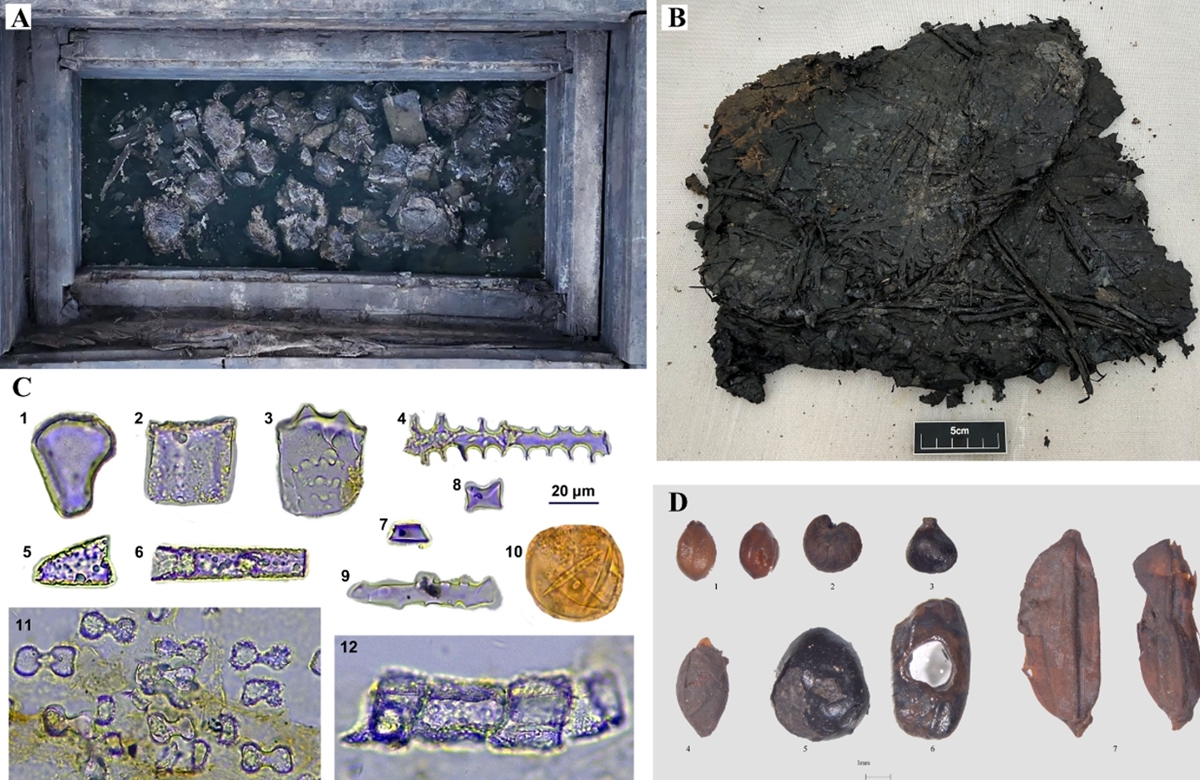
In March 2024, archaeologists from the National Center for Archaeology excavated a large number of well-preserved, waterlogged plant bundles from the tomb's outer coffin chamber. On-site, the plant bundles could be seen tightly wrapped in broad leaves and tied with plant-fiber cords.
A team of researchers led by the National Center for Archaeology, IVPP, and the Chinese Academy of Social Sciences examined 12 of the bundles and found that the wrapping leaves came from oak trees, while the cords were made from grasses.
The bundles mainly contained rice, broomcorn millet, foxtail millet, and cereal seeds, most of which were still in their husks and mixed with inflorescence material. Small amounts of peppercorn, mallow and rice-field weed seeds were also found.
The fact that the bundles were found in a tomb and mainly contained grains still in their husks suggests they were not everyday food, but offerings intended for funerary rituals. "This might reflect a Warring States-era belief that grains served as wealth for the dead in the underworld," Ge Yong, an associate researcher at the IVPP and the study's corresponding author, told the Global Times.
A Qin Dynasty (221BC-206BC) text describes a belief that "soybeans were gold and millet was money" for the dead, indicating that grains held symbolic significance in funerary culture. "The bundles therefore appear to have been ritual offerings prepared for the deceased," Ge said, "not food for the living."
The physical structure of the bundles also resembles that of zongzi, with grains wrapped in leaves and tightly secured with plant-fiber cords. "Similar practices of wrapping grains for burial have also been found elsewhere within the Chu cultural sphere," Ge said, "such as at the Chengyangcheng Site."
At the Chengyangcheng archaeological site in Henan Province, rice and broomcorn millet were also discovered wrapped in oak leaves. "An interesting fact is that we can still find zongzi wrapped with the same oak leaves now in regions related to the Chu cultural sphere."
"The findings suggest that wrapping grains as funerary offerings was a relatively common practice in the Chu state during the Warring States period," Ge said. "And this practice may have been an early form of the zongzi later associated with the legend of Qu Yuan."
These plant bundles share a structure similar to that of modern zongzi and to those described in legends and folklore. This might reflect how, through cultural exchange and heritage, these 2,200-year-old plant bundles likely evolved over centuries, shifting from sacrificial offerings to food, said Ge.
As diverse regional populations adapted the practice, it eventually transformed into the well-known Dragon Boat Festival tradition of eating zongzi. Thus, this structural resemblance might suggest a potential historical lineage; however, experts stressed that the Wuwangdun bundles should not simply be labelled as ancient zongzi.
"We can't define these plant bundles as the earliest zongzi, but rather, we can confirm that by 2,200 years ago at the latest, the Chu region had established a tradition of using this specific form of plant bundles for funeral rites. And this tradition could be a possible origin or precursor of the well-known zongzi," said Ge.
He added that the discovery provides critical physical evidence to explore the origins of zongzi and its cultural heritage.
。

B | 4月28日,重庆燃气集团股份有限公司公布关于对重庆市燃气领域群众反映问题联合调查组调查结果整改情况的公告。 公告表示,对于联合调查组在调查结果中指出燃气企业存在的错抄和违规估抄、燃气计费周期混乱、价格政策执行不到位、换表工作组织无序、工作力量严重不足以及内部监督管理不到位等问题,公司深刻反思、深感自责。据统计,多计多收气费1182件,影响气量1218950立方米,涉及金额2858545.83元,公司已全部清退处置完毕。 重庆燃气集团股份有限公司公布整改情况: 开通燃气计量服务快速通道,通过增加热线服务24小时值班人员、设立线下受理服务点等方式,已清退处置多计多收气费285.8万元。 调整气费信息账单模版,增补用气地址、抄表起止日期、用气天数、阶梯气量及剩余用量、账户资金等信息,定期规范透明向客户推送用燃气量、价、费用等信息。

C | 对内部经营管理和客户服务工作进行全面诊断,围绕关键控制环节、责任落实、考核评价以及监督问责等,进行流程优化和制度完善。 重庆燃气表示,公司郑重承诺,将坚持把惠民生的事办实、暖民心的事办细、顺民意的事办好。

D | 真诚感谢广大市民和客户的监督和帮助,欢迎社会各界朋友继续对提出批评意见、对公司各项工作进行监督。 4月19日晚,重庆燃气集团官网公告,根据重庆市联合调查组对燃气公司计量收费情况的调查结果,经研究决定,免去车德臣重庆燃气集团股份有限公司党委书记、总经理职务,提请股东大会免去其董事长职务;任命李金陆为重庆燃气集团股份有限公司党委书记、总经理职务提名其为董事长人选。 上级单位将派驻工作组进驻重庆燃气集团,对本次调查发现的问题督促重庆燃气集团进行全面彻底的整改,同时开展深入细致的自查工作,积极整改、提升服务,如发现工作不力、违规违纪行为将予以严肃追责问责。

E | (图源网络 中国小康网综合央视新闻、第一财经、封面新闻)。
Current article:http://8jaib.loukachunwenghongchuikui.shop/list_gpqchh/n0r.html
Published on:11:25:57
 经过基因改造的浮萍可能是一种更可持续的生物燃料来源
 'बिहारी को शौचालय...तेजस्वी भूल गए क्या', सीएम स्टालिन के बिहार दौरे पर बीजेपी का अटैक
 iPhone 18 Pro Max包装盒流出:清新配色撞脸远峰蓝 一秒梦回iPhone 13 Pro
 炸锅!17岁张本美和连斩国乒3将登顶WTT,未来3年谁能拦住她?
 Prices in West Bank Continue to Soar; Local Employee Says Palestinians Can Hardly Make Ends Meet
 上半年外贸进出口总值同比增6.2倍 雄安新区对外开放活力持续迸发
 AI重塑千亿级产业逻辑 钱塘如何抢占“AI+医药”新赛道?
 SpaceX裁员内幕人士:马斯克召开员工会议并扼杀宣布裁员
 斯洛伐克总理菲佐首次出庭受审,他的病情虽然严重,但情况稳定
 “越权且不负责任”,俄美共同批评联大主席贝尔伯克
 中埃军演惊喜太多!埃及首次拿出阵风参演,歼16扮演以色列王牌战机,兵器杂志肖宁,原创 中埃军演惊喜太多!埃及首次拿出阵风参演,歼16扮演以色列王牌战机